
How to Get Free Things in Madrid
Furniture, clothes and free outings
In Madrid, "free things" can mean two things: items for your home or outings with no entry fee. This guide covers both. First, where to get furniture, clothes and kitchenware: the city's reuse scheme, charities and neighbours. Then, free museums, parks and tours with their opening times.
| Resource | What you can get | How to access it |
|---|---|---|
| ReMAD at puntos limpios | Reusable items | Reserve on remad.es and collect at the punto limpio within 7 days |
| ReMAD reuse centres | Large furniture and appliances | remad.es catalogue |
| Cáritas roperos (clothing banks) | Clothes and shoes | Cáritas intake at your parish |
| District social services | Guidance on clothes and basic household goods | Appointment via 010 |
| Street furniture collection | Furniture left out by neighbours | One night a month in your area |
| Waki and neighbourhood groups | Furniture, clothes, kitchenware, books | Chat and a pickup with the neighbour |
| Clothing and item swaps | Assorted items | Neighbourhood and district agendas |
Step by step: where to look, depending on the item
- Large furniture or appliance: browse the ReMAD (city reuse service) catalogue on remad.es and reserve what you need. You collect it at the punto limpio where it's kept, within 7 days.
- Furniture, no rush: check on the Geoportal (online map) which night the furniture collection runs in your neighbourhood. Walk around between 21:00 and 23:00 and inspect anything you find carefully.
- Small item (kitchenware, clothes, books, toys): look on Waki for what neighbours near you are giving away, message them through the app's chat and arrange a pickup.
If you're furnishing from scratch, see our guide on how to furnish your apartment for free in Spain.
Where else to find free items in Madrid, beyond apps
For large furniture and appliances, the city's own scheme is the first place to check.
Puntos limpios and ReMAD
ReMAD is the city's free item-exchange service. On remad.es you verify your mobile number, upload a photo of the item you want to give and reserve what you need. It runs on points: each item you drop off earns 100 and each item you take costs 50.
Items are stored at the city's 16 puntos limpios fijos (fixed recycling and drop-off points), and what you reserve is collected at the punto limpio where it's kept. You have 7 days to pick it up; if you don't, you can't make reservations for 7 days.
To find your nearest punto limpio, search your address on the City Council's Geoportal (online map). The puntos limpios fijos open Monday to Saturday from 8:00 to 20:00, and on Sundays, public holidays and 24 and 31 December from 9:00 to 14:00.
Since September 2025, ReMAD also takes large furniture and appliances. These go to Centros de Reutilización de Residuos (reuse centres) with reception areas, refurbishment workshops and a display space. The first to open was Villaverde, at Calle San Norberto, 44. If you're moving into an empty flat, check the catalogue often.
Street furniture collection
Each neighbourhood has one night a month for the recogida programada (scheduled collection) of furniture, appliances and household goods. That night, neighbours leave them on the pavement next to the nearest bin between 21:00 and 23:00, with no need to book. To find out which night it is on your street, type your address into the Geoportal map viewer and click on the map. If something is useful to you, inspect it carefully before taking it home, especially sofas and mattresses.
Cáritas clothing banks and social services
For clothes and shoes, Cáritas runs roperos (charity clothing banks) through parish churches. You usually don't go straight to the ropero: first you visit the Cáritas acogida (intake service) at your parish. At San Juan de la Cruz, for example, intake runs on Wednesdays from 19:00 to 20:30 outside summer. Each ropero has its own hours and requirements, so call first.
To ask for clothes or basic household goods through the city, book an appointment at your district's centro de servicios sociales (social services centre). You can do it on 010 (914 800 010 from outside Madrid) or at madrid.es/citaprevia; they're open Monday to Friday, 9:00 to 13:00 and 15:00 to 19:00. Explain what you need and ask about clothing banks in your neighbourhood.
Swap markets and giveaway groups
At a trueque (swap) you bring something in good condition and take something else in return. Dates change from month to month, so the practical thing is to follow an agenda. The trueque section of Convócala Madrid, a grassroots cultural agenda, lists swaps and clothing exchanges; also check your junta de distrito's (district council's) agenda.
Ask your residents' association or parish whether there's a giveaway group in your area too. And if you don't mind paying a little, the city's flea markets have almost everything at low prices.
How to use Waki to find free items near your neighbourhood
If you'd rather get something hand to hand from a neighbour, Waki is a free app to donate or swap household items and food with people nearby, available on iOS and Android. Madrid is where it has the most activity, and the community has more than 6,000 registered people, with about 70 new people every week. You browse what's posted nearby, chat through the app to arrange a pickup, and there's no money or haggling. If it's your first time, read how to get started with Waki.
Compared with ReMAD, Waki works better for small items someone hands to you: you don't go to a punto limpio or spend points.
Waki es la solución que estaba buscando, encuentro cosas útiles y regalo otras, no más acumulación en este hogar 🙂 (translation: Waki is the solution I was looking for: I find useful things and give others away, no more clutter in this home 🙂)
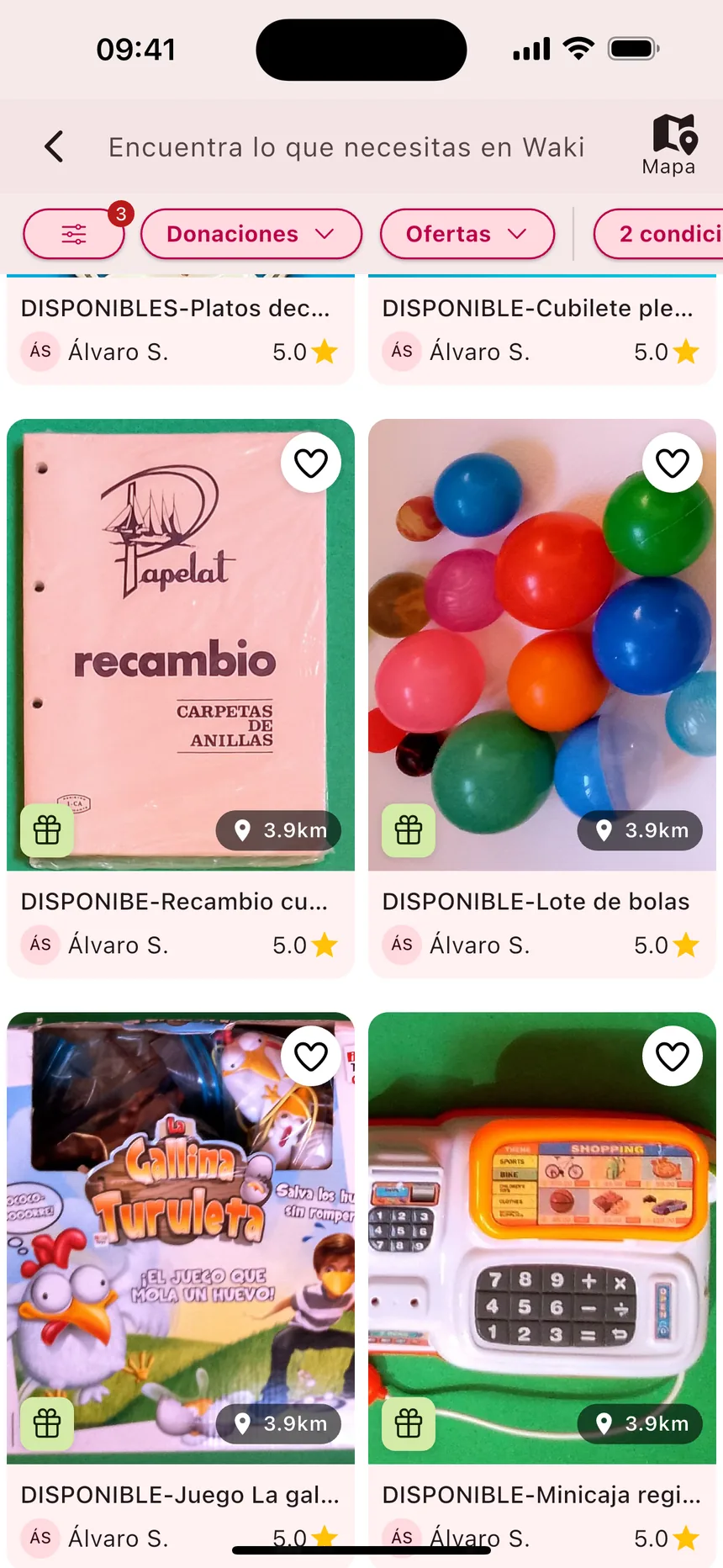
To compare options, we have a roundup of barter apps in Spain.
How to pick up a free item without paying for transport
Free stops being free if you have to hire a van. Before arranging a pickup, measure the item and plan how you'll move it. If you take the Metro with something bulky, avoid rush hour.
For large furniture, ask the person giving it away whether they can bring it closer, or combine several pickups in one van rental. For small items like a book or a frying pan, BiciMAD (the city's public bike-share) and a backpack are usually enough.
For safety, meet in a public place and in daylight whenever possible. If you need to go up to a flat to collect furniture, bring someone with you and let a friend know where you are.
Free things to do in Madrid: museums, parks and tours
Opening times checked in October 2026 on esMADRID, the city's tourism site, and on each venue's website. They can change, so confirm before you go.
Museums and monuments
| Place | When it's free |
|---|---|
| Museo del Prado | Monday to Saturday, 18:00-20:00; Sundays and public holidays, 17:00-19:00 |
| Museo Reina Sofía | Monday and Wednesday to Saturday, 19:00-21:00; Sundays, 12:30-14:30 |
| Museo Thyssen | Mondays, 12:00-16:00 (collection); Saturdays, 21:00-23:00 (temporary exhibitions) |
| Palacio Real (Royal Palace) | Monday to Thursday, 17:00-19:00, for EU and Latin American citizens |
| Templo de Debod and Almudena Cathedral | Always free |
| Ermita de San Antonio de la Florida | Always free, Tuesday to Sunday; Goya frescoes |
| Museo de Historia and Museo de San Isidro | City museums, always free |
| Chamberí station (Andén 0) | Free, guided visit with advance booking online; limited capacity |
Parks and gardens
| Park | Good to know |
|---|---|
| El Retiro | Open every day |
| Casa de Campo | Madrid's largest park |
| Madrid Río | Riverside walk along the Manzanares |
| Sabatini Gardens and Campo del Moro | Next to the Royal Palace; Campo del Moro opens every day |
| El Capricho | Saturdays, Sundays and public holidays only |
Cultural centres and guided tours
Matadero, the former slaughterhouse in Madrid Río, and the Conde Duque cultural centre are on esMADRID's always-free list. Check their agenda before you go.
The Biblioteca Nacional (National Library) offers free guided tours on Mondays, Wednesdays and Fridays at 12:00 and 17:00, with online booking, according to Guía del Ocio.
Pasea Madrid is the City Council's free guided tour programme. It runs in seasons (March-April, May-July and November-December) and takes you to places that are usually closed, such as a Civil War bunker. Booking is online and places go fast, so note the day registration opens.
FAQ: getting free items in Madrid
Is it safe to meet a stranger to pick up something free? As with any meetup with strangers, take basic precautions. Chat first through the app, meet somewhere busy and during the day, and bring someone if the item is in a private home. If something feels off, don't go.
Is there a limit on how many items I can ask for? Between neighbours there's no fixed number, but ask only for what you'll use and collect what you ask for. On ReMAD, your points set the limit. If you change your mind, let the person know so someone else can have it.
What should I do when I no longer use something I got for free? Put it back into circulation. You can post it on Waki with a photo, take it to a punto limpio through ReMAD or check where to donate what you no longer use. That way the item keeps helping another neighbour.
Related articles
 Practical Guides
Flat Clearance in Madrid: Prices and Steps
What flat clearance costs in Madrid by size and service, how to book the free council furniture collection and what to donate before you hire.
 Practical Guides
10 Foolproof Tricks to Free Up Space at Home and Save Space Smartly
Discover how to free up space at home with these 10 tricks. Learn to save space using Waki, the free donation app in Madrid
 Practical Guides
How to Get Started with Waki
Everything you need to know to take your first steps on Waki and start donating and swapping with your community.